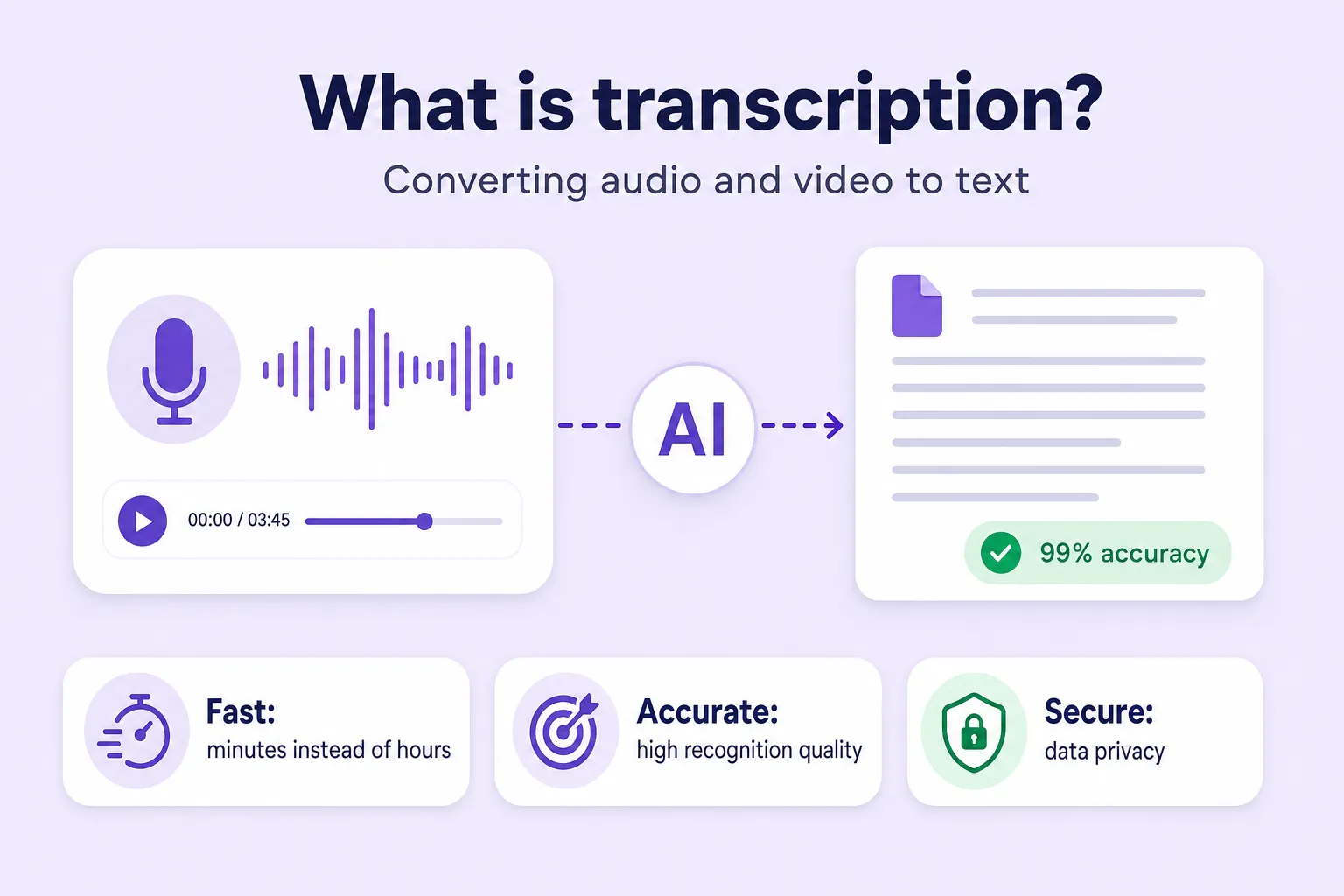
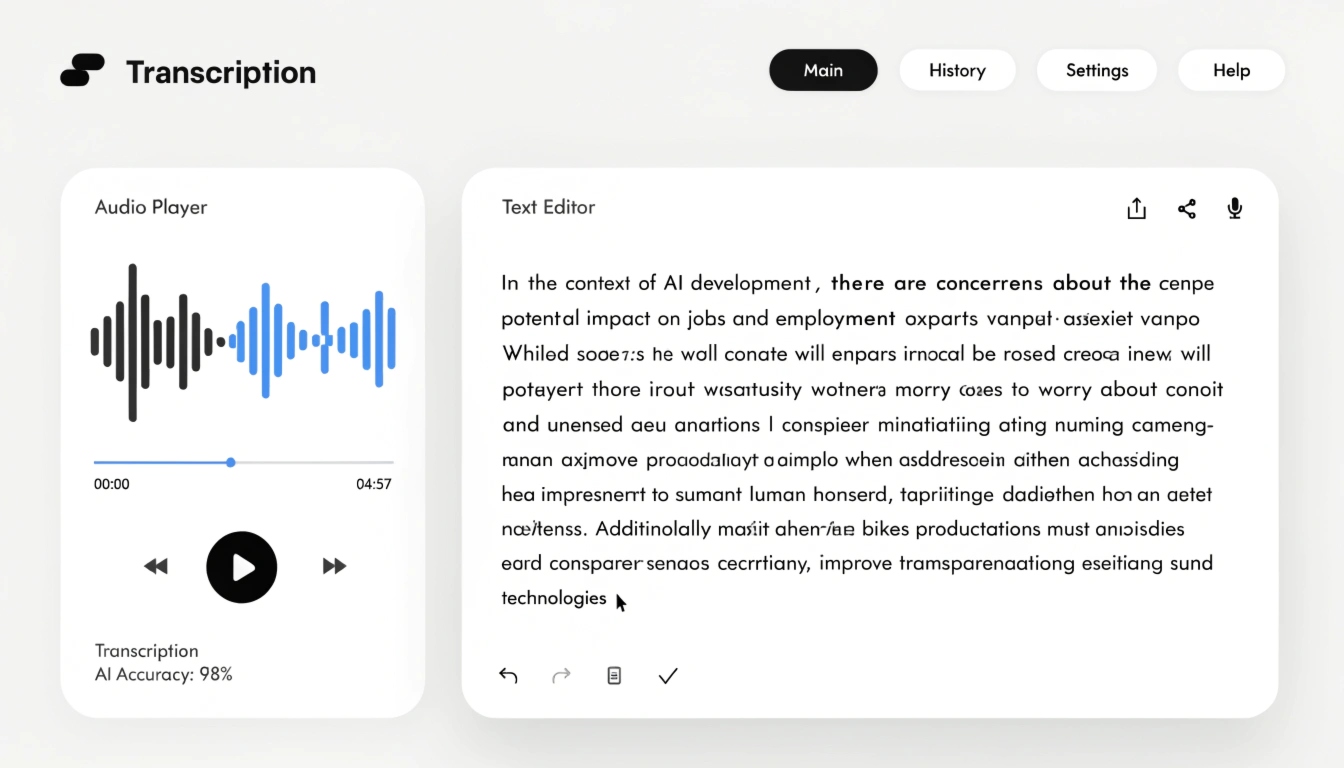
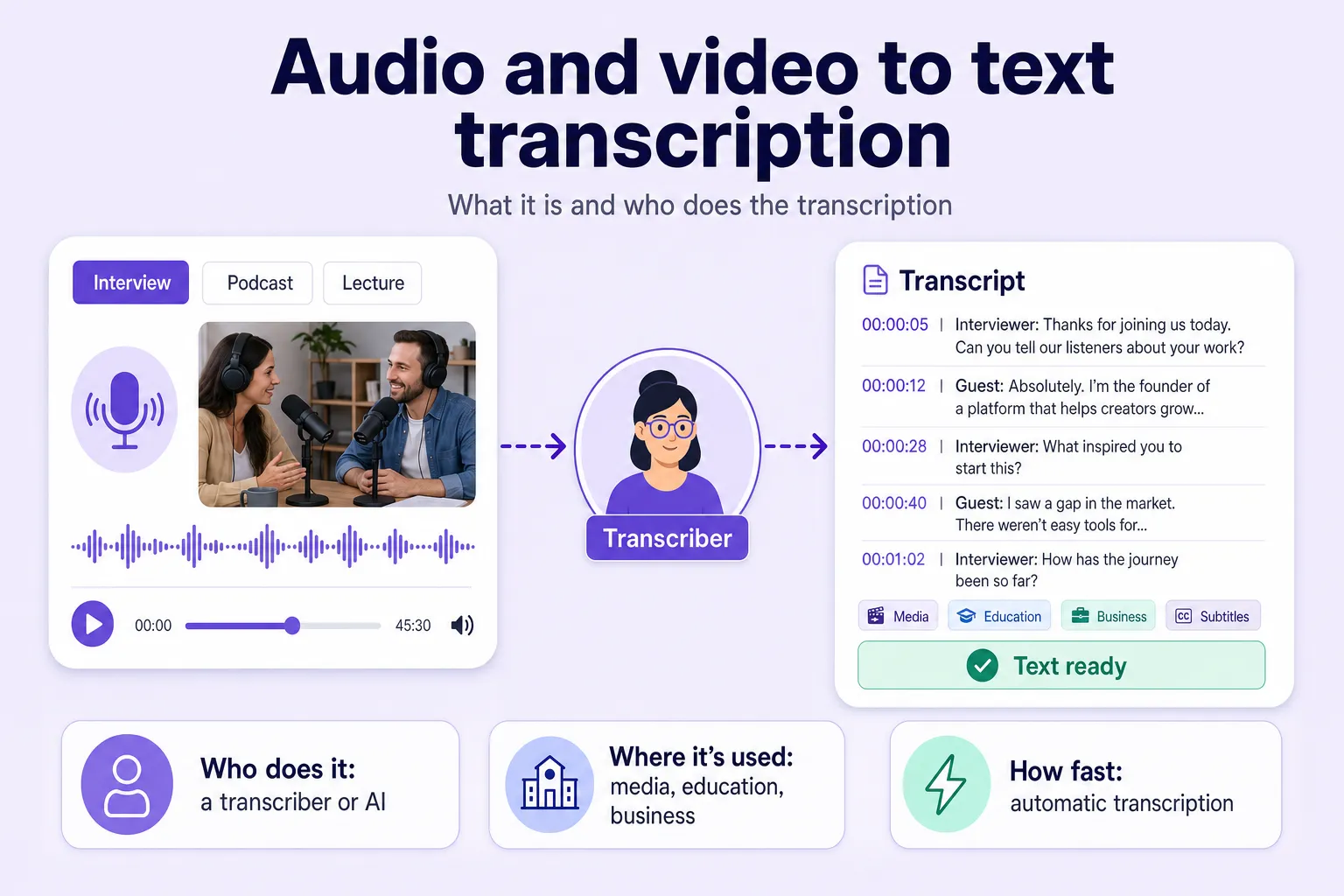
Transcription is the process of converting spoken words from audio or video recordings into written text. Turning audio into text lets you quickly and conveniently get a text version of speech for further analysis, storage or publication. Transcription is used across many fields: journalism, education, business, medicine and law.
At its core, transcription relies on speech recognition technology — a system that uses artificial intelligence and machine learning algorithms to automatically detect sounds and turn them into text. Automatic transcription is dramatically faster than traditional manual decoding while still delivering high accuracy. In this article we look at the main types of transcription, how recognition technology works and the stages of working with audio recordings.
Types of transcription: manual and automatic
Transcribing audio and video is the process of converting spoken words, captured in a sound or video format, into a text document. This gives you a text version of interviews, lectures, podcasts, video conferences and other material, which makes information easier to search, analyse and archive.
That text can be used to create subtitles, prepare reports, research content or improve accessibility for people who are deaf or hard of hearing. Converting audio to text has become an essential tool in modern communication and in working with large volumes of data.
There are two main types of transcription — manual and automatic. Manual transcription is done by a person who listens carefully to a recording and types the text out by hand. This approach delivers high accuracy, especially with difficult recordings that contain noise, several speakers or specialised terminology. However, it takes a considerable amount of time and comes at a high cost.
Automatic transcription is based on speech recognition and artificial intelligence. Software and online services convert audio into text in a matter of minutes. This method saves time and resources, but accuracy can vary depending on the quality of the recording and the complexity of the material.
Automatic transcription is often used for a first-pass draft, which is then reviewed and corrected by hand.
How speech recognition technology works
Speech recognition technology is a set of algorithms and methods that automatically convert spoken speech into a text format. The process begins with processing the audio signal: the sound is broken into small pieces, and the characteristics of each one are analysed — frequency, amplitude and timing. The system then compares these against phonemes, the smallest sound units of a language, matching sounds to known patterns to form words and phrases. Context and grammar rules help correct possible errors and improve recognition accuracy.
As the technology has evolved, more sophisticated models have appeared that account not only for acoustic characteristics but also for linguistic features, which significantly improves the quality of speech-to-text conversion. Such systems can adapt to different voices, intonations and even dialects.
AI and machine learning in speech recognition
Modern speech recognition technology makes heavy use of artificial intelligence (AI) and machine learning. During training, models are fed huge volumes of audio data together with their accurate text transcripts. By analysing this data, the system learns to recognise different accents, speaking rates and background noise, and to tell several speakers apart.
Deep neural networks and recurrent models let systems process sequences over time efficiently and predict likely words from context. This is especially important when recognising complex, multi-speaker recordings, as well as specialised terminology.
Using AI makes it possible to continuously improve speech recognition, reducing errors and increasing transcription speed. Learning models become more accurate and adaptive as they gain experience.
Advantages and limitations of recognition technology
Speech recognition technology speeds up transcription dramatically compared with typing text out by hand. It can quickly convert large volumes of audio material into text, saving time and resources.
However, its effectiveness and accuracy depend on several factors. The quality of the source recording plays a key role: noise, echo and slurred speech all reduce recognition accuracy. Accents, dialects and several people speaking at once also create difficulties for the algorithms. In such cases errors and inaccuracies are possible, and they require follow-up manual review and correction.
In short, speech recognition is a powerful tool, but achieving high transcription quality sometimes calls for a combined approach that pairs automatic decoding with human specialists.
Automatic transcription — how it works
Automatic transcription is the process of converting speech into text using specialised software built on speech recognition technology. Unlike manual decoding, it requires no human involvement at the conversion stage, which significantly speeds up processing. The software automatically analyses the audio track, recognises words and forms text while accounting for grammar and linguistic features. As a result, it works at high speed even with large volumes of data. You can try it yourself with our audio-to-text and video-to-text tools.
Accuracy and quality of automatic transcription
The accuracy of automatic transcription depends directly on a few factors.
First, the quality of the source recording: background noise, echo and distortion all lower the result.
Second, the complexity of the speech — several speakers, a fast pace, accents and slang can all make the task harder for the algorithms.
Modern systems use advanced AI models that learn from large volumes of data and constantly improve. Even so, it is not yet possible to eliminate errors entirely, so in professional settings a combined approach is common — automatic transcription followed by manual review and correction. This delivers the best balance of speed and quality.
Examples of using automatic transcription services
Automatic transcription has found broad application across many areas of work.
In media it is used to create text versions of interviews, podcasts and video material.
In education it helps prepare lecture notes and study materials.
In business it is used to minute meetings, webinars and conferences, making later analysis and decision-making easier.
In legal practice, transcription helps produce court records and documents.
Modern services support many audio and video formats, offer a convenient interface and integrate with other tools. That is why automatic transcription has become an indispensable assistant for streamlining work with speech and data. You can transcribe speech online or explore the full set of transcription tools.
Preparing and processing audio files
The quality of the source audio affects transcription accuracy. Before converting, it is worth doing a few preparation steps:
- Check the recording for background noise, stray sounds, echo and distortion.
- If needed, process the audio with noise-reduction and filtering software.
- Make sure the volume and clarity of the speech meet the standards required for recognition.
This kind of preparation improves recognition quality and reduces the likelihood of errors in the text.
The file format matters too: modern services support many formats, but some are preferable in terms of quality and processing speed.
Audio and video formats for transcription
Today most transcription platforms support the popular audio and video formats, including:
- Audio: MP3, WAV, M4A, AAC, OGG, AIFF, AMR.
- Video: MP4, MOV, MKV, AVI, FLV.
Some platforms let you upload video directly, automatically extracting the audio track for further processing. Choosing the right format and a good-quality recording makes conversion faster and more accurate.
Stages of converting audio to text
The conversion process involves several key stages:
- Uploading the file. You upload an audio or video file to the transcription platform through a web interface or API.
- Analysing the audio signal. The system processes the audio track, splitting it into segments to improve recognition and simplify processing.
- Speech recognition. Speech recognition technology — AI and machine learning algorithms such as Whisper by OpenAI — converts the audio into text, taking phonetics, grammar and context into account.
- Building the text document. From the recognised words the system forms a text file, structured by time and by logical blocks, ready to export to formats such as SRT, DOCX, XLSX or TXT.
- Review and editing. Automatic transcription is often followed by a correction stage that can be done by hand to fix errors caused by noise, accents and difficult vocabulary.
To improve transcription accuracy, use good recording equipment, keep noise levels down and, for difficult recordings, combine automatic decoding with manual editing.